Common Cờ Nhào Mistakes: Parity Blindness, Self-Blocking, and Forgetting the Reply Chain
Common Cờ Nhào mistakes: parity blindness, self-blocking, and forgetting the reply chain
The earlier Cờ Nhào tactics article covered the decisions strong players make: choosing landing squares, declining captures, hunting the 1-vs-1 finish. This one looks from the other side — four mistakes that make beginners and intermediate players lose games they "don't understand how they lost". None of them is about calculating further ahead; all four are about misreading the board's structure.
1. Parity blindness: not every point has diagonals
The Cờ Nhào board is a 5×5 Alquerque web: horizontal and vertical lines exist at every point, but diagonals are drawn only from points where (column + row) is even. The consequence few players notice: a disc standing on an "odd" point has at most 4 lines — it cannot jump diagonally and cannot escape diagonally. A disc on an "even" point has up to 8 lines; the board's centre is the classic even hub.
The classic mistake: parking a disc on an odd point and calculating as if it controlled the diagonal region around it — it controls none of it. The mirror error is attacking an enemy disc on an odd point along an imaginary diagonal that doesn't exist on the board. The fix is a cheap habit: before every move, classify your disc's landing point in your head — even points are traffic hubs, odd points are narrow corridors. Any disc that will need to jump again or flee next turn belongs on an even point.
2. Self-blocking: you can lose with discs still on the board
Cờ Nhào's ending rules have a branch beginners forget: the side to move with no legal move loses — even with several discs still standing. A disc sealed in by enemy discs and the board's edge, with no empty neighbouring point to step to and no enemy in jump range, is dead without ever being captured.
This loss is mostly self-inflicted: pushing discs into corners and along edges too early, then filling the last empty point next to your own group with a "harmless" move. To avoid it, keep every group of yours at least one empty neighbouring point — a breathing door — and be suspicious of any move that spends that last door, unless the move wins on the spot. The attacking mirror: when your opponent's last group is nearly sealed, don't chase captures — plugging their final breathing door is faster and cleaner.
3. Counting only your own chain — forgetting the opponent's longest reply
A three-disc chain feels wonderful, and it blinds players to the more important question: after your chain, what is the longest chain your opponent can answer with? A jump chain rewrites the whole board — it vacates landing points, leaves your disc deep in enemy territory, and sometimes opens the road for a longer counter-chain.
The honest score of a chain is: discs you take minus discs the opponent takes back on the very next turn. A chain that takes 3 and concedes 4 is a losing chain, however spectacular it looks. Before the first jump, spend a few seconds finding the opponent's maximum chain in the position after your move — this is exactly how the game's hint engine evaluates positions. If the balance is negative, stop the chain earlier or jump with a different disc.
4. Breaking the opening "wall" too soon
Cờ Nhào's opening: 10 discs per side fill the two home rows, and the middle row starts completely empty. A disc can only be jumped when the point directly behind it — along the jump's direction — is empty. Which means a disc with a friendly disc standing directly behind it cannot be jumped from that direction. The two starting rows are therefore a self-covering wall: every disc has a teammate guarding its back.
The most common opening mistake is eagerly pushing one lone disc into the middle row. It loses its cover instantly, and worse, it becomes a ladder rung for the opponent: they jump it, land deep in your half, and start a chain from there. The correct principle: advance in pairs or clusters, so the leading disc always has support closing the landing point behind it; the first disc to cross should be one whose covering disc you can bring up right behind it next turn.
Where to practise these four habits
Play the computer on SynerWorlds with a per-session contract: one session spent only classifying even–odd points before every move; another with an absolute ban on filling your own group's last breathing door. The daily Cờ Nhào puzzle is also a good gym for counting reply chains — its compressed positions force you to read jumps in both directions.
- Play now: Cờ Nhào
- Rules refresher: How to play Cờ Nhào
- Level up further: Cờ Nhào tactics: capture chains and the art of the landing square · Cờ Gánh endgames: winning by blockade and liberty races
📚 Continua a leggere
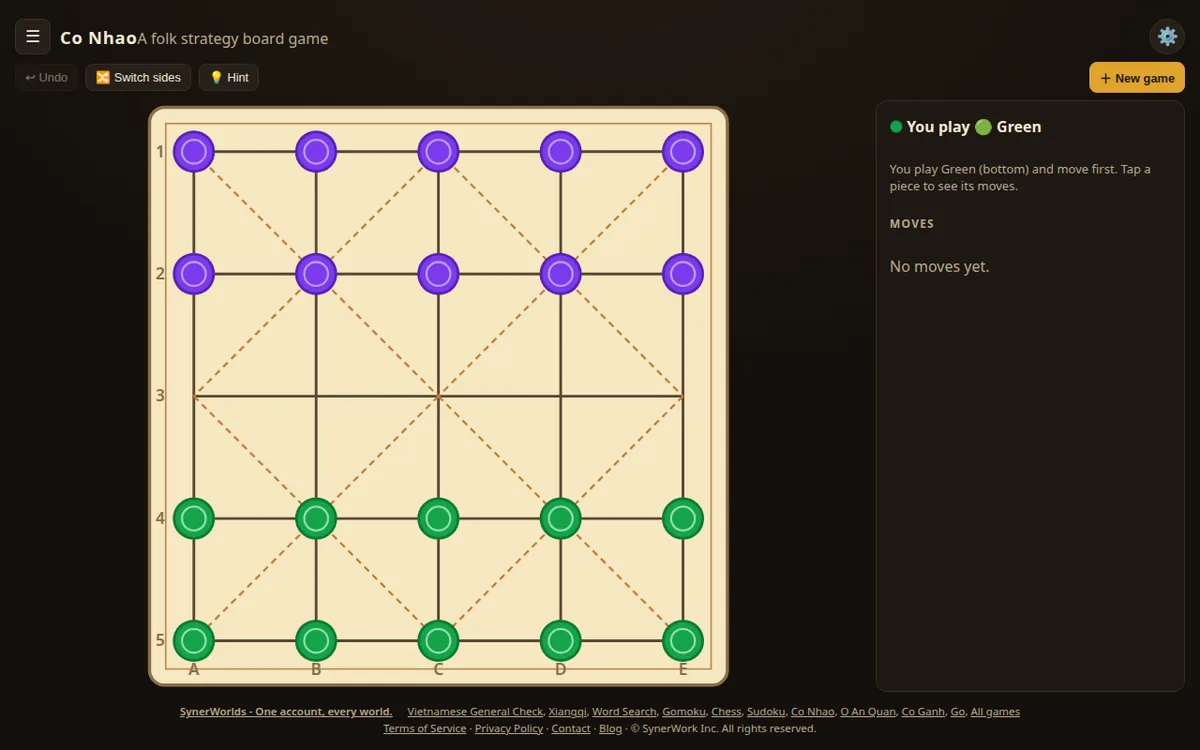
Cờ Nhào Tactics: Capture Chains and the Art of the Landing Square
Read the landing square before the chain, know when to decline a capture, think in networks of empty points, and use the 1-vs-1 draw rule on time — four decisions that make a strong Cờ Nhào player.
"Co Nhao — a beginner's guide"
Co Nhao** is a Vietnamese folk game on a 5×5 board (Alquerque-style). Each side has **10 discs**; the middle row starts empty. Green (bottom side) moves first. Win by capturing every enemy piece...
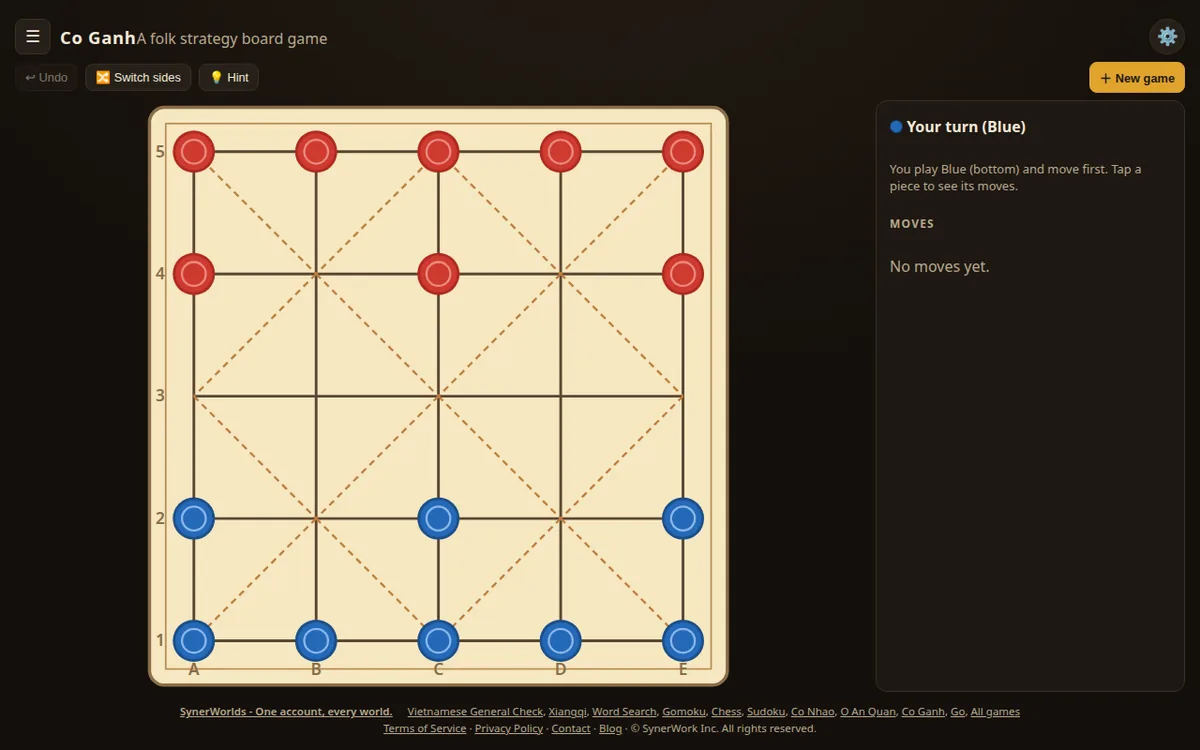
Cờ Gánh Endgames: Winning by Blockade, Liberty Races, and the Two Faces of the Fortress
As the board thins, Cờ Gánh becomes arithmetic: winning by leaving the opponent no move, liberty races between mutually surrounded groups, the endgame carry trap, and why a self-surround fortress can become a coffin.
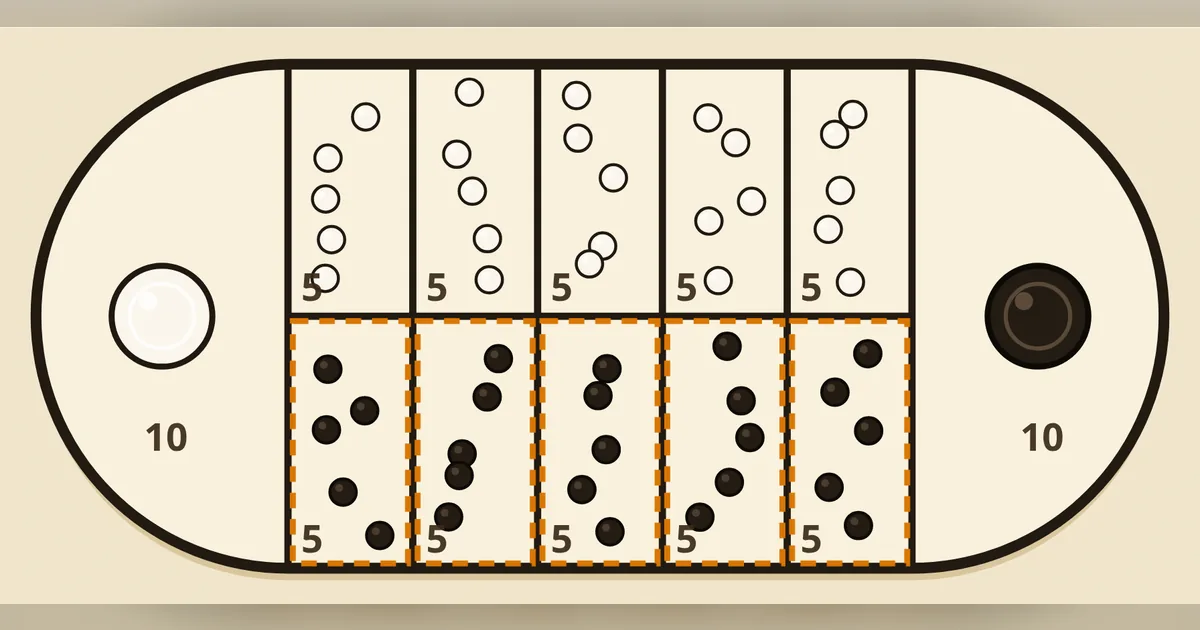
Ô Ăn Quan vs Mak Khom: One Mancala Family, Two Philosophies of Sowing
Vietnam's Ô Ăn Quan and Thailand's Mak Khom (หมากขุม) sow seeds into stores the same way but differ on everything else: free vs fixed sowing direction, forward chain captures vs the sideways kin thaen, a reseed tax vs a game-ending sweep — and which skills transfer.
Commenti
Ancora nessun commento. Sii il primo a condividere la tua opinione!