Tablebases: When Chess Endgames Are Already Solved
Tablebases: When Chess Endgames Are Already Solved
Some questions in chess no longer need anyone to sit and think. Not because a stronger player has appeared, but because the answer was computed in advance and stored in a database: this position is a win, a draw or a loss — with absolute precision. That database is called a tablebase, and it has changed how we understand endgames at the root.
What is a tablebase?
A tablebase is a database containing a complete, exhaustive analysis of every position with few pieces left on the board. For each position, the tablebase records whether the side to move wins, draws or loses when both sides play perfectly, and how many moves it takes to get there.
The remarkable part is how it is built: retrograde analysis. Instead of calculating forward from the current position — nearly impossible, since the possibilities explode exponentially — the computer starts from every checkmate position and works backwards one move at a time, spreading out across the whole space of positions. A position from which every move leads to a loss for the opponent is a win, and the reasoning propagates from there. When the process closes, no position is left "unknown": every single one has an answer.
There are two ways of measuring the "distance to the goal" that players should distinguish:
- DTM (depth to mate): the number of moves to checkmate, when mate is the only thing being counted.
- DTZ (depth to zeroing): the number of moves to a "clock-resetting" move — a capture or a pawn move — because under the 50-move rule, a game is drawn if fifty moves pass with neither.
This difference is not academic: tablebases are computed ignoring the 50-move rule, so some positions the tablebase calls a theoretical win would be declared drawn in a real game before mate arrives, if the winning side fails to produce a resetting move in time. When you read a tablebase result, remember it answers the question "what is this position, really?" — the rules of competition are a separate layer on top.
The scale: 424 trillion positions
Today, every position with seven or fewer pieces (both kings included) has been solved: 423,836,835,667,331 positions in total — roughly 424 trillion. Not a single seven-piece position on Earth remains a mystery.
The first complete seven-piece tablebase was produced in 2012, computed on the Lomonosov supercomputer at Moscow State University, and took about 140 TB of data. Later, Ronald de Man's Syzygy format compressed those same results down to 18.4 TB — small enough for engines on a personal computer to look up directly in the middle of a game.
The most famous record unearthed by tablebases is a forced mate in 549 moves: White has King, Rook, Bishop and Knight against Black's King and two Knights. This position — found by Guy Haworth in the Lomonosov data — has exactly one winning first move; play anything else and the win slips away. No human, and no engine without tablebase access, plays that position correctly from start to finish. Five hundred forty-nine consecutive perfect moves lie far beyond any direct calculation — we know of it only because someone computed backwards from the destination.
Engines and tablebases: judgement versus certainty
In our anatomy of chess engines, we examined how Stockfish and its relatives play chess: they search forward through millions of positions per second and evaluate which ones look better. An engine is so strong that at any level a human can perceive, it almost never errs — but in essence, an engine's conclusion is still a judgement: "this looks winning." Give the engine more time, and that conclusion can occasionally change.
A tablebase does not judge. It looks up. When a position has seven or fewer pieces, the answer is a mathematical fact, proven by exhaustive enumeration — not the opinion of any program or player. That is why, in the practice of verifying composed positions, the order of trust is always: the tablebase adjudicates the root position first; the engine only guides the way in positions with more pieces; and a published solution line counts as proven only when it reaches a position the tablebase can decide conclusively.
Tablebases corrected us twice in one day
That is the theory. Here are two real cases from our own work building SynerWorlds' Chess Position Dictionary. The dictionary now holds more than 1,300 positions, and an entry earns its "verified" label only on proof: either a forced mate whose entire solution line has been replayed and validated move by move, or a solution line that reaches a position of seven or fewer pieces which the tablebase decides.
The first case is Saavedra — perhaps the most famous endgame study in the world, dating from 1895, about a pawn that looks held to a draw but wins by promoting to a Rook instead of a Queen. On re-checking, we discovered that our own dictionary's Saavedra entry carried a one-square transcription slip: the black rook stood on d4 instead of d5. One square off, and the conclusion flips completely: with the rook on d4 the position is a draw; only on d5 is it the classic win. The tablebase adjudicated the root position instantly, and on 5 November 2026 we corrected the entry, with a public correction note right on the position's page.
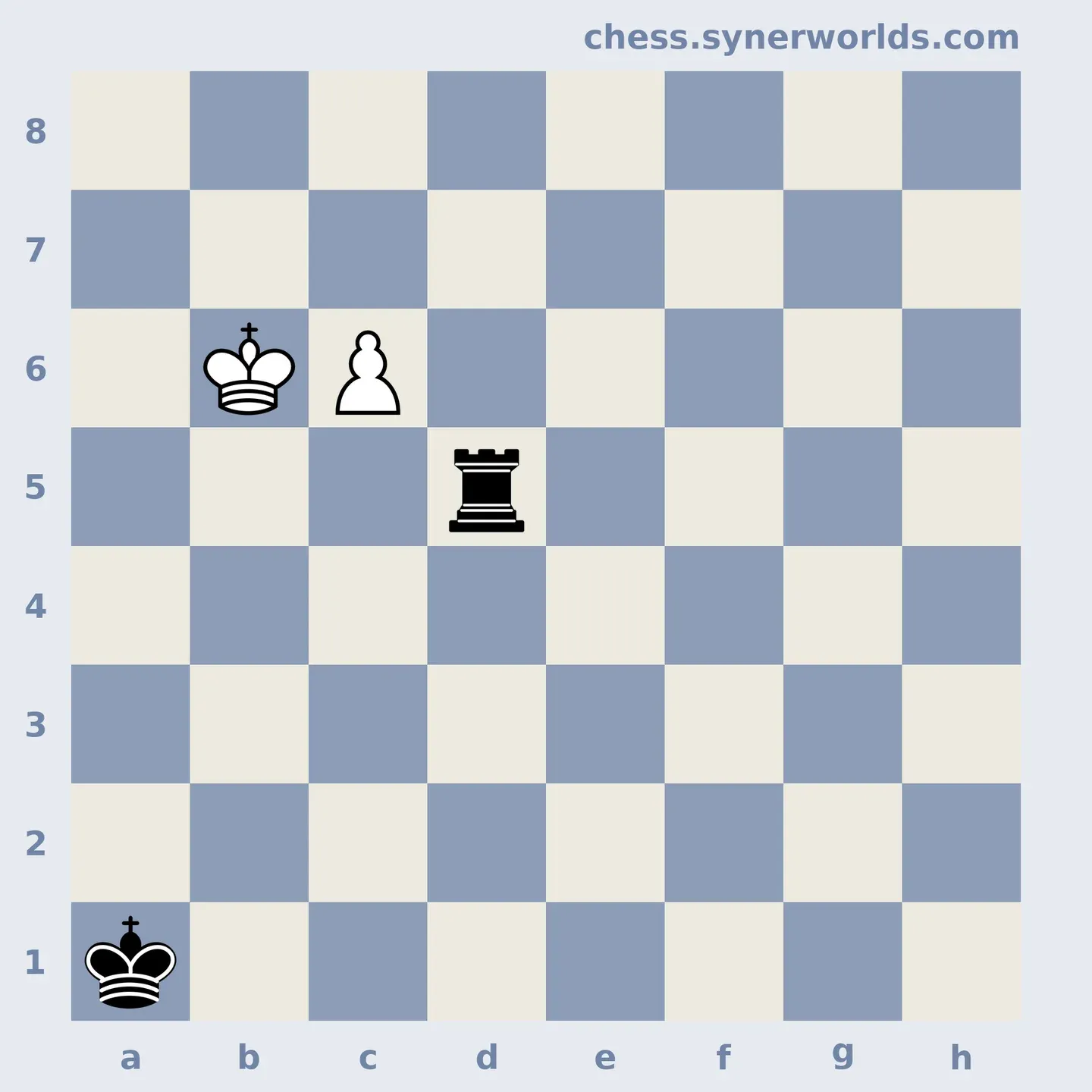
The correct Saavedra position: black rook on d5 — the tablebase verdict is a win for White.
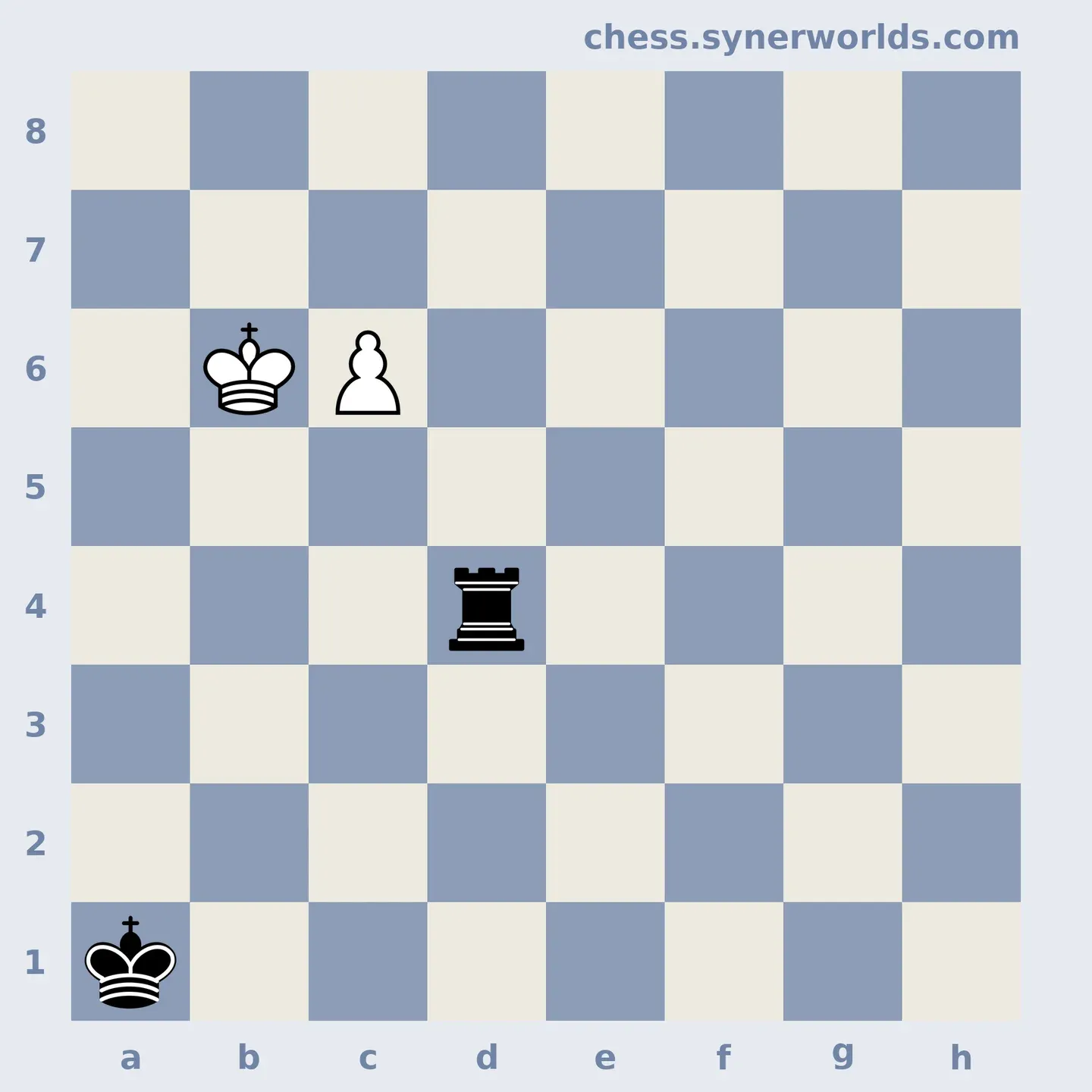
The same position with the black rook one square lower, on d4: the tablebase verdict flips to a draw.
The second case ran the other way: a study by Henri Rinck, published in 1927 as a draw. The root position has exactly seven pieces, and the tablebase is unambiguous: it is a win for Black. The line printed in the book only draws because, on its third move, Black plays a move that throws the win away. This position became the dictionary's first "disputed" entry: the book says one thing, the proof says another, and we record both so readers can see for themselves.
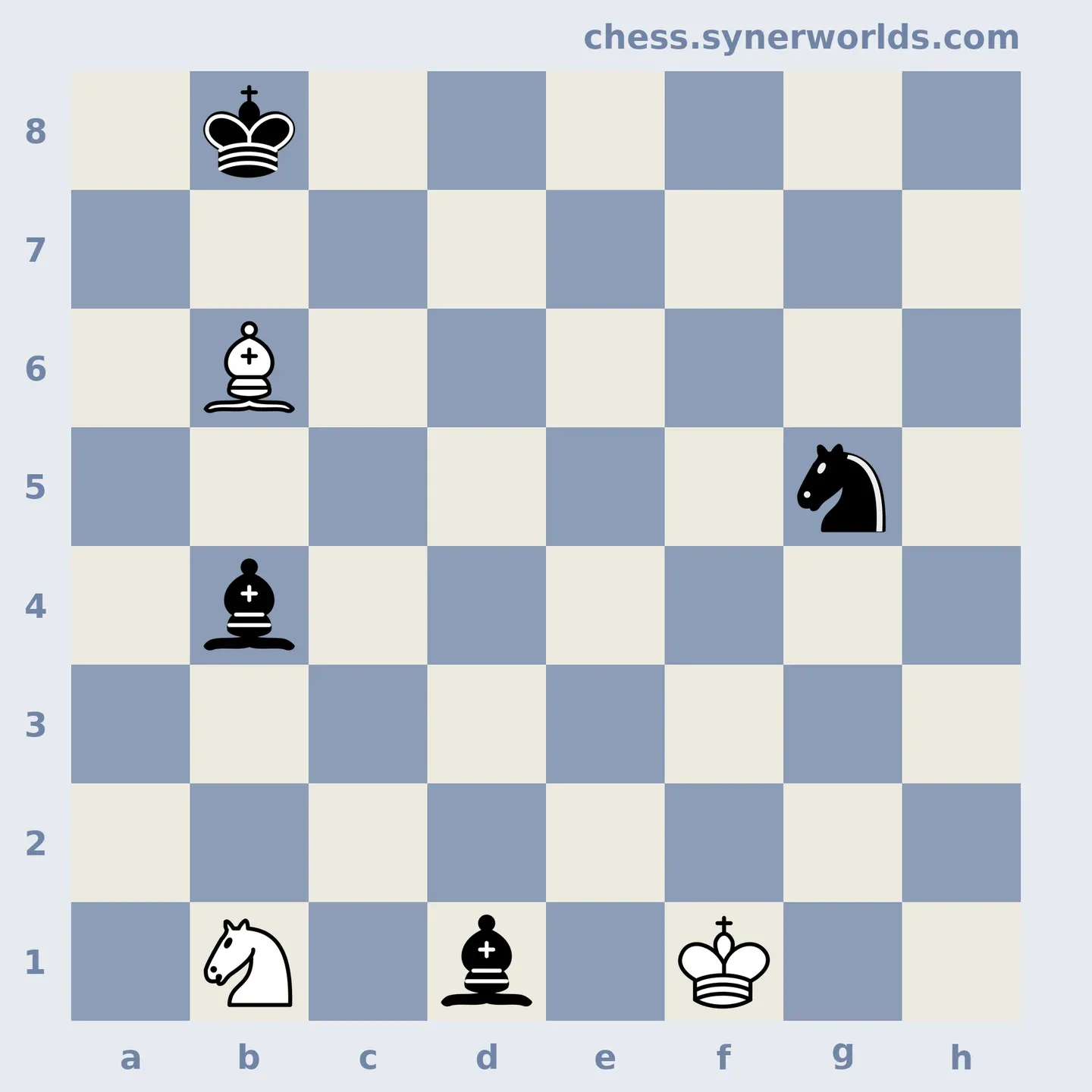
Henri Rinck's 1927 study: published as a draw, proven by the tablebase to be a win for Black — the dictionary's first disputed entry.
The lesson — now a hard rule of the dictionary — is to always adjudicate the root position with the tablebase before replaying any printed solution line. A diagram copied one square wrong can make an entire "correct" solution be built on the wrong position.
The limits: chess is not solved
To be clear: tablebases have not "solved chess." They have solved only endgames with seven or fewer pieces. Eight-piece tablebases are still a work in progress — in 2022, Marc Bourzutschky found a win in 584 moves within the portion computed so far — but the complete set does not exist, and each added piece multiplies the workload exponentially. In openings and middlegames, chess remains the territory of judgement — of engines and of humans.
But within its domain, the tablebase has the final word. If your game reduces to seven pieces, the answer is already sitting in those 18.4 TB of data, waiting to be looked up.
Come and look one up
Visit the Chess Position Dictionary: pick an endgame position, check its verification label, play through its solution yourself, or open it in the Setup board and compare against what the tablebase declares. The position you have long believed to be winning might just be worth looking up once.
Comments
No comments yet. Be the first to share your thoughts!