Ô Ăn Quan vs Mak Khom: One Mancala Family, Two Philosophies of Sowing
Ô Ăn Quan vs Mak Khom: one mancala family, two philosophies of sowing
Vietnam's Ô Ăn Quan and Thailand's Mak Khom (หมากขุม) are siblings in Southeast Asia's great mancala family — cousins of Malaysia and Indonesia's Congkak. Both begin from the same image: scoop up a handful of seeds, sow them around a ring, and try to harvest as many as possible into your store. But sit down and play both, and nearly every important decision turns out different — to the point where skill in one game is both an asset and a trap in the other.
The boards: one game has "mandarins", the other only seeds
Ô Ăn Quan plays on a 12-cell ring: 5 citizen cells (ô dân) per player and one large mandarin cell (ô quan) at each end. Every citizen cell starts with 5 stones (50 citizen stones on the board), and above all there are two special mandarin tokens — each worth 10 citizen stones at scoring. On SynerWorlds, Ô Ăn Quan plays with 2 to 4 players, the ring expanding with the player count.
Mak Khom plays on a 16-cell ring: 7 ordinary pits per player and one store (hua mueang) at the end of each side. The whole board is 98 completely uniform seeds, 7 per pit to start — no special pieces, no mandarins, and strictly 2 players. The only value is the number of seeds sitting in your store when the round ends.
The philosophies show already in the setup: Ô Ăn Quan is a game with big prizes (the two mandarins); Mak Khom is a game of pure accumulation.
Sowing: free direction and the next cell — or a fixed circuit and the landing cell
In Ô Ăn Quan, every pickup lets you choose the sowing direction — clockwise or counter-clockwise — and choose again at each relay. Its relay rule looks at the next cell: after your last stone drops, if the cell right after it is a citizen cell holding stones, you pick that cell up and keep sowing. Sowings pass through mandarin cells and drop stones into them (gradually "ripening" the mandarin) but a mandarin cell is never picked up.
In Mak Khom, the sowing direction is fixed around the ring — no choice at all. Passing your own store you drop a seed in; the opponent's store is skipped entirely. Its relay rule looks at the landing cell: if your last seed falls into a pit that already holds seeds (on either side), you pick that whole pit up and keep sowing. And if your last seed lands exactly in your own store, you scoop another of your pits — an "extra turn" Ô Ăn Quan doesn't have; there, long turns are built from relays and capture chains instead.
Capturing: look forward — or look across
Capturing in Ô Ăn Quan looks forward: after the last stone, if the next cell is empty and the cell beyond it holds stones, you take that cell — and captures chain as long as the empty–full pattern repeats. The mandarin is protected by the quan non ("young mandarin") rule: a mandarin cell holding fewer than 5 citizen stones cannot have its token captured yet.
Capturing in Mak Khom looks sideways: if your last seed lands in an empty pit on your own side — folk terminology calls it the seed "dying" (mak tai) — you capture the entire opposite pit across the board, plus the capturing seed itself, all into your store. If the opposite pit is empty, you take only the dead seed. A last seed dying on the opponent's side does nothing at all. And Mak Khom captures never chain: at most one capture per move.
One game captures in a straight line, in chains; the other captures across a mirror line, exactly once. It is the deepest tactical difference between the two.
When one side runs out of seeds: a tax — or a finishing blow
This is where the two philosophies collide head-on. The same event — your side has no seeds left in its ordinary cells:
- In Ô Ăn Quan, the game does not stop. The feeding rule makes you reseed 5 stones from your own captured pile (one per cell) to keep playing; run short and you borrow from your opponents, with the debt deducted from your final score. Running dry is a tax.
- In Mak Khom, the moment one side's 7 pits are all empty the round ends immediately, and every seed still standing in pits anywhere on the board is swept into the store of the player whose side just emptied. Emptying your own side is a finishing blow: you collect everything left in the opponent's pits. (Careful in the mirror direction: a capture across the board that accidentally empties the opponent's last pit hands that very sweep to them.)
Endings and scoring
Ô Ăn Quan ends the moment both mandarin tokens have been captured. Your score is captured citizen stones plus 10 per mandarin, minus borrowing debt; citizen stones still standing on each side's home cells are collected by that side's owner, while stones stranded inside mandarin cells score for nobody.
Mak Khom ends with the sweep described above; your score is simply your store, and equal stores draw. Traditionally, Mak Khom is contested as multi-round matches under the mueang mai ("widow town") format — the loser of a round enters the next one at a disadvantage, making for long, gruelling contests. The Mak Khom on SynerWorlds deliberately chooses a single-round format, cleaner and fairer for online play — a ruling of the digital version, stated openly so players used to the traditional format aren't surprised.
Which skills transfer between the two?
Three skills are the common capital of the whole mancala family: counting before you pick up (working modulo the ring — 12 cells or 16 — to know where the last seed lands), reading relationships between cells instead of isolated cells, and endgame sense — knowing when to close the game.
But three things must be relearned when you cross over. First, direction thinking: Ô Ăn Quan players, used to choosing a direction at every pickup, feel handcuffed by Mak Khom's fixed circuit, while Mak Khom players arriving in Ô Ăn Quan keep forgetting they're allowed to sow backwards. Second, capture geometry: looking forward (empty cell, full cell) is a different instinct from looking across (empty home pit, full opposite pit). Third, your attitude to emptying land: the Ô Ăn Quan instinct to "keep the land alive" will make you miss Mak Khom's finishing sweep, while Mak Khom's race-to-empty habits, carried into Ô Ăn Quan, will just have you paying the reseed tax over and over.
Play both, in one place
Both games are free to play right in the browser on SynerWorlds — Ô Ăn Quan for 2–4 players, Mak Khom for 2 — with one account for both.
- Play now: Ô Ăn Quan · Mak Khom
- Learn more: The Ô Ăn Quan page · How to play Ô Ăn Quan · Introducing Mak Khom: rules and the kin thaen capture
- Go deeper on Ô Ăn Quan: Ô Ăn Quan strategy: count the seeds, chain the captures, never let your land burn
📚 Verder lezen
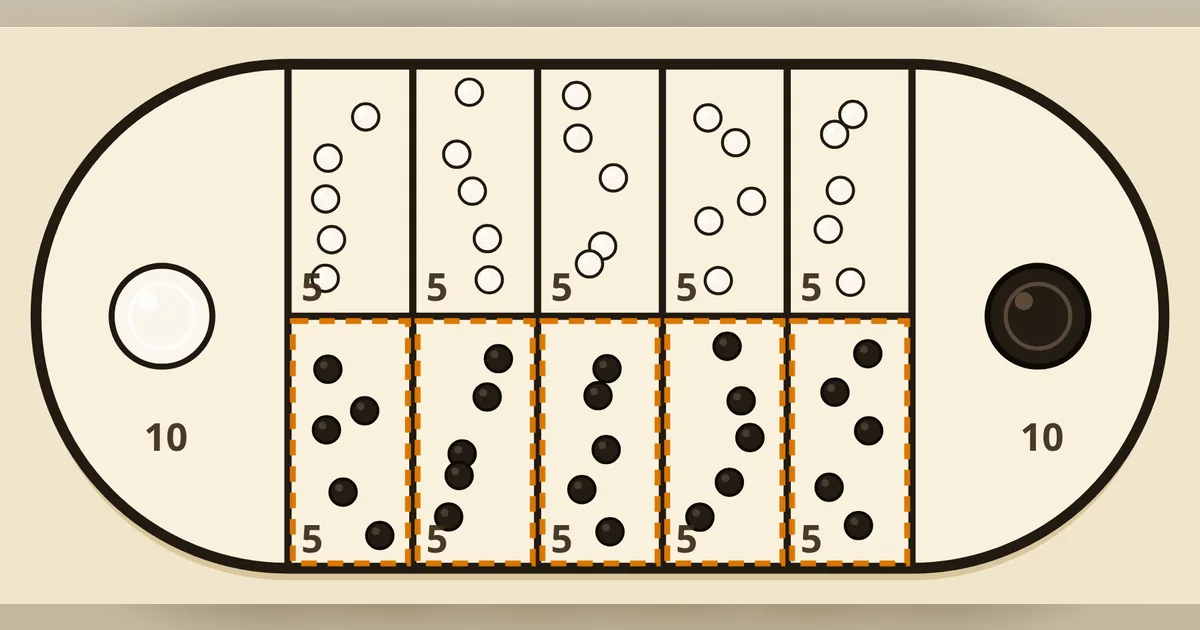
Ô Ăn Quan Strategy: Count the Seeds, Chain the Captures, Never Let Your Land Burn
Ô Ăn Quan is deterministic arithmetic on a 12-cell ring: count where the last stone lands, build empty-full bridges for capture chains, watch both mandarins ripen past 5 stones, and avoid the 5-stone reseed tax.
"O An Quan — a beginner's guide"
O An Quan** ("Mandarin Square Capturing") is Vietnam's beloved mancala-style folk game. The board is a **ring of 12 pits** (2-player game): 10 small dân (citizen) pits and 2 large quan (mandarin)...
Mak Khom (หมากขุม) is live: the Thai sowing game of relay drops and kin thaen captures
Mak Khom (หมากขุม) is live at makkhom.synerworlds.com — the Thai folk sowing game of the Congkak family: relay sowing, store-landing bonus moves, kin thaen opposite captures, a 12-level AI, two-player rooms, interactive lessons and a daily puzzle.
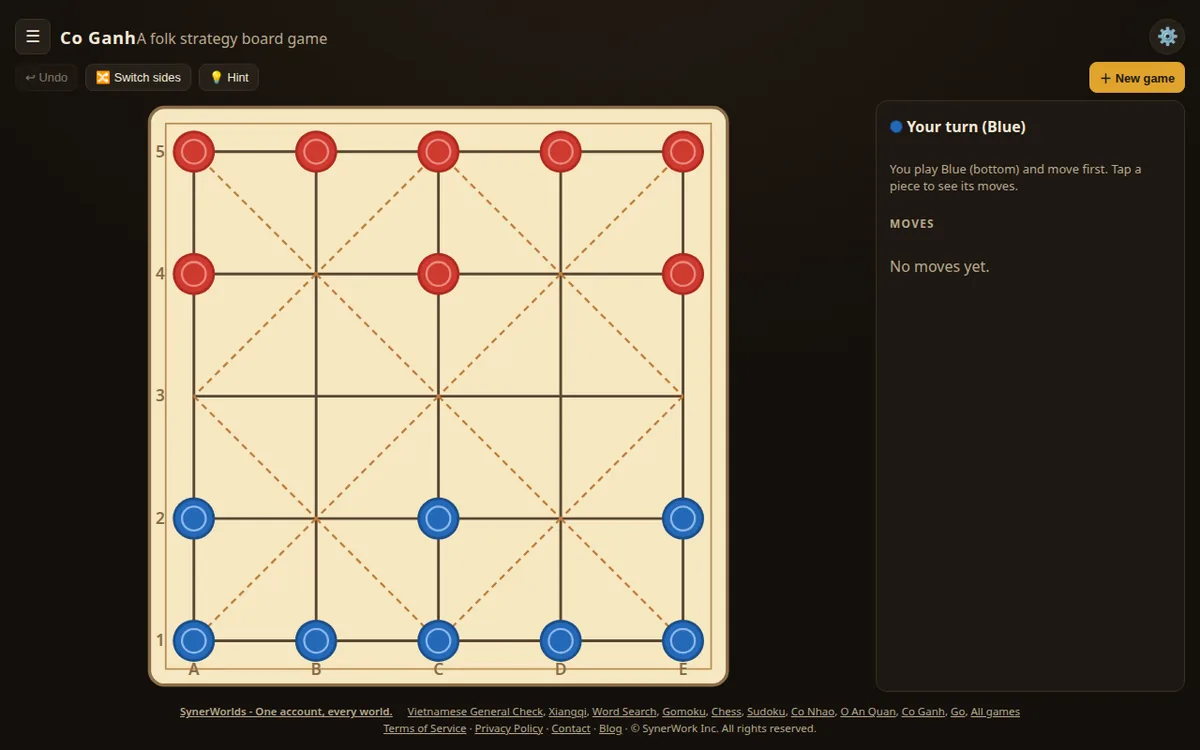
Cờ Gánh Endgames: Winning by Blockade, Liberty Races, and the Two Faces of the Fortress
As the board thins, Cờ Gánh becomes arithmetic: winning by leaving the opponent no move, liberty races between mutually surrounded groups, the endgame carry trap, and why a self-surround fortress can become a coffin.
Reacties
Nog geen reacties. Wees de eerste die je mening deelt!