Ô Ăn Quan Strategy: Count the Seeds, Chain the Captures, Never Let Your Land Burn
Ô Ăn Quan strategy: count the seeds, chain the captures, never let your land burn
Ô Ăn Quan looks like a game of handfuls and luck, but played by its real rules it is an almost fully deterministic arithmetic puzzle: the ring has only 12 cells, every stone is visible, and the outcome of a move is decided entirely by counting. The five skills below separate players who "sow by feel" from players who actually steer the game.
1. Count before you pick up: where the last stone lands decides everything
A quick recap of one move: you pick up every stone in one of your dân (citizen) cells and sow one stone per cell in a direction of your choice. Once the last stone drops, the next cell decides what happens: if it is a dân cell holding stones, you pick that cell up and keep sowing (choosing the direction again); if it is empty and the cell beyond it holds stones, you capture that cell; in every other case — the next cell is a mandarin cell, or the cell beyond the empty one has nothing worth taking — the turn ends. In other words, a move's entire value lives in its final landing cell.
So the foundational Ô Ăn Quan skill is counting before touching a stone: the number of stones in your chosen cell, worked around the 12-cell ring, tells you exactly which cell the last stone falls in — before your hand moves. Strong players never pick up a cell whose last stone's destination they haven't named in their head. A few sessions of this habit and the whole game slows down and clarifies: every decision starts from arithmetic, not hope.
2. Chain captures: build an empty–full "bridge" along one direction
A single capture takes one cell; the real power is the capture chain — consecutive captures following the empty → occupied pattern: after capturing a cell, if the next cell is again empty and the one beyond holds stones, you capture again. One rule detail matters enormously: once a capture chain starts, the turn continues only through captures — there is no going back to relay sowing. Chains must therefore be prepared in advance, over earlier turns.
Decent players actively sculpt the ring: leaving empty and full cells alternating along one sowing direction, like a bridge the opponent doesn't notice. When your last stone lands in rhythm just before the first empty cell, the whole bridge collapses into your store in a single turn — sometimes including a mandarin cell. The defensive mirror: a fat cell of yours with an empty cell directly in front of it (along the opponent's sowing direction) is a loaded trap aimed at you. Never let empty–full pairs line up pointing into your land.
3. Quan non: watch both mandarin cells ripen
A mandarin is the board's biggest prize: each quan token scores 10 citizen stones at settlement. But mandarins wear armour — the quan non ("young mandarin") rule: while a mandarin cell holds fewer than 5 dân stones, the token inside cannot be captured. Once the cell accumulates 5 or more stones, the mandarin is "ripe" and becomes capturable by anyone whose sowing produces the empty→mandarin pattern.
That turns both mandarin cells into countdown clocks you must watch constantly. Every sowing that passes a mandarin cell drops another stone into it — including your own careless relays, which can ripen your mandarin for the opponent to harvest. Conversely, when the enemy mandarin ripens, that is the moment to build a capture pattern aimed straight at that cell: taking a mandarin plus its accompanying stones is usually the biggest single swing of the game.
4. Never let your land burn: the 5-stone reseed tax
Ô Ăn Quan's feeding rule is brutally practical: if all five of your dân cells are empty at the start of your turn, you must reseed — take 5 stones from your own captured pile and place one in each cell so you have something to play with. If your pile runs short, you borrow from your opponents, and the debt is deducted straight from your final score.
The tactical consequence is clear: letting your land burn means paying a tax of at least 5 stones out of your own winnings. Strong players always keep at least one "seed cell" alive at home — and sometimes a quiet sowing move that drops a stone back into an empty home cell is worth more than a small capture, because it cancels next turn's tax. The attacking mirror is just as sharp: a capture that sweeps the last stones from the opponent's remaining dân cells forces them to pay the reseed tax from their pile — a 3-stone capture that triggers the enemy's 5-stone tax is really an 8-stone move.
5. The endgame: the game stops the moment the last mandarin falls
Unlike most scoring games, Ô Ăn Quan doesn't end by rounds: the game stops the instant both mandarin tokens have been captured. At that moment, every stone standing on each side's five dân cells is collected by that side's owner — but stones sitting inside the two mandarin cells belong to nobody.
Endgame arithmetic therefore has two consequences. First: late in the game, your stones standing on your own dân cells are guaranteed points, while stones stranded in a mandarin cell are lost money — prefer sowings that finish on your home cells over ones that pile stones into a mandarin cell. Second: taking the final mandarin is a decision, not a reflex. Capture the last quan while your side of the board is fat and the enemy's is thin, and you freeze the game in a winning settlement; grab it while your own land is empty and you freeze a loss. Sometimes the correct final move is to not take the mandarin yet, and sow one more lap to fatten your home cells first.
Where to practise
Play Ô Ăn Quan against the computer on SynerWorlds with a counting drill: before every move, whisper the name of the cell the last stone will land in — when you're wrong, stop and work out why. After a few dozen games, "seeing" the whole sowing chain before picking up becomes a reflex.
- Play now: Ô Ăn Quan
- Introduction & rules: The Ô Ăn Quan page · How to play Ô Ăn Quan
- A relative across the border: Ô Ăn Quan vs Mak Khom: one mancala family, two philosophies of sowing
📚 Συνεχίστε την ανάγνωση
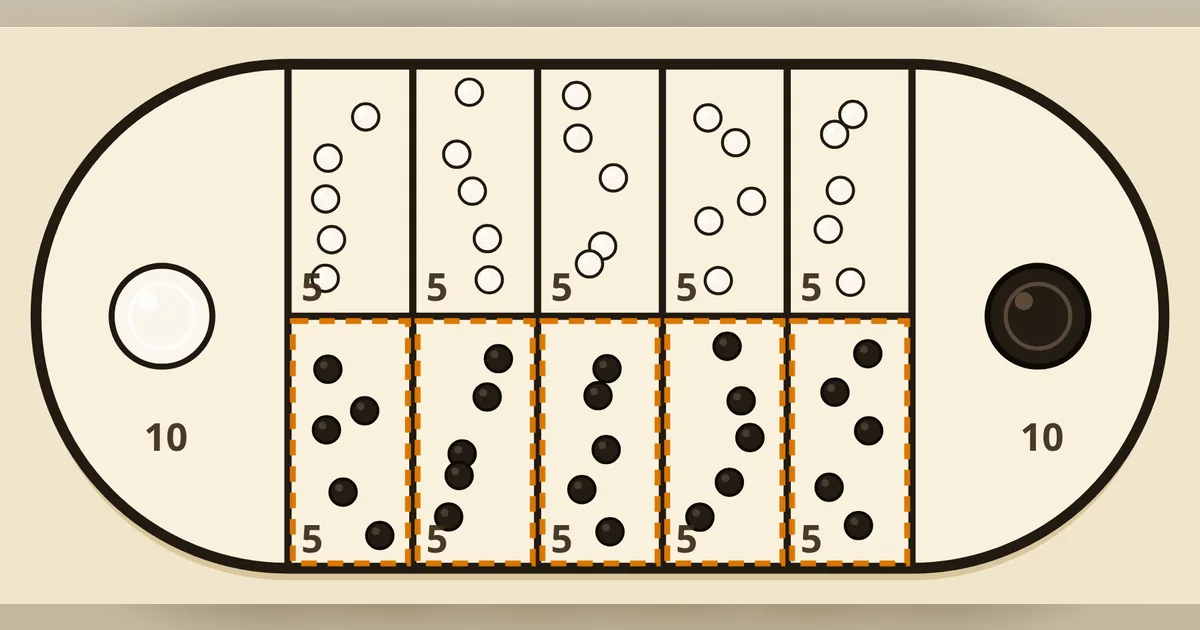
Ô Ăn Quan vs Mak Khom: One Mancala Family, Two Philosophies of Sowing
Vietnam's Ô Ăn Quan and Thailand's Mak Khom (หมากขุม) sow seeds into stores the same way but differ on everything else: free vs fixed sowing direction, forward chain captures vs the sideways kin thaen, a reseed tax vs a game-ending sweep — and which skills transfer.
"O An Quan — a beginner's guide"
O An Quan** ("Mandarin Square Capturing") is Vietnam's beloved mancala-style folk game. The board is a **ring of 12 pits** (2-player game): 10 small dân (citizen) pits and 2 large quan (mandarin)...
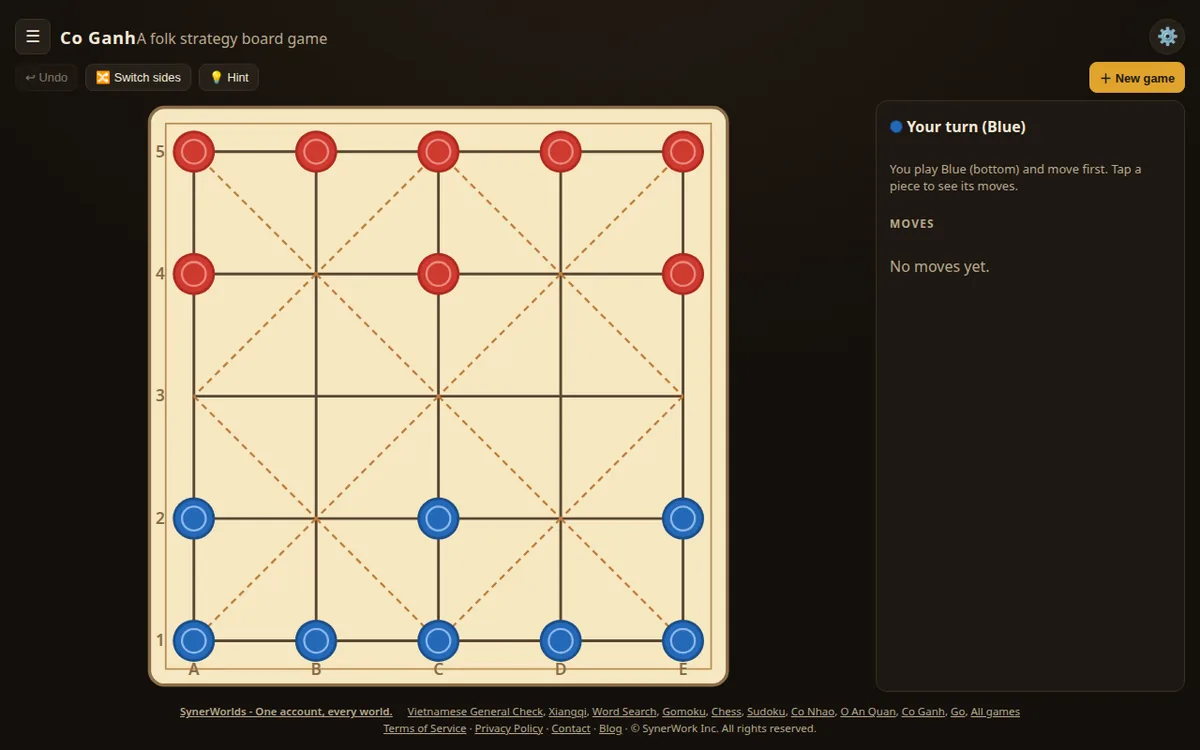
Cờ Gánh Endgames: Winning by Blockade, Liberty Races, and the Two Faces of the Fortress
As the board thins, Cờ Gánh becomes arithmetic: winning by leaving the opponent no move, liberty races between mutually surrounded groups, the endgame carry trap, and why a self-surround fortress can become a coffin.
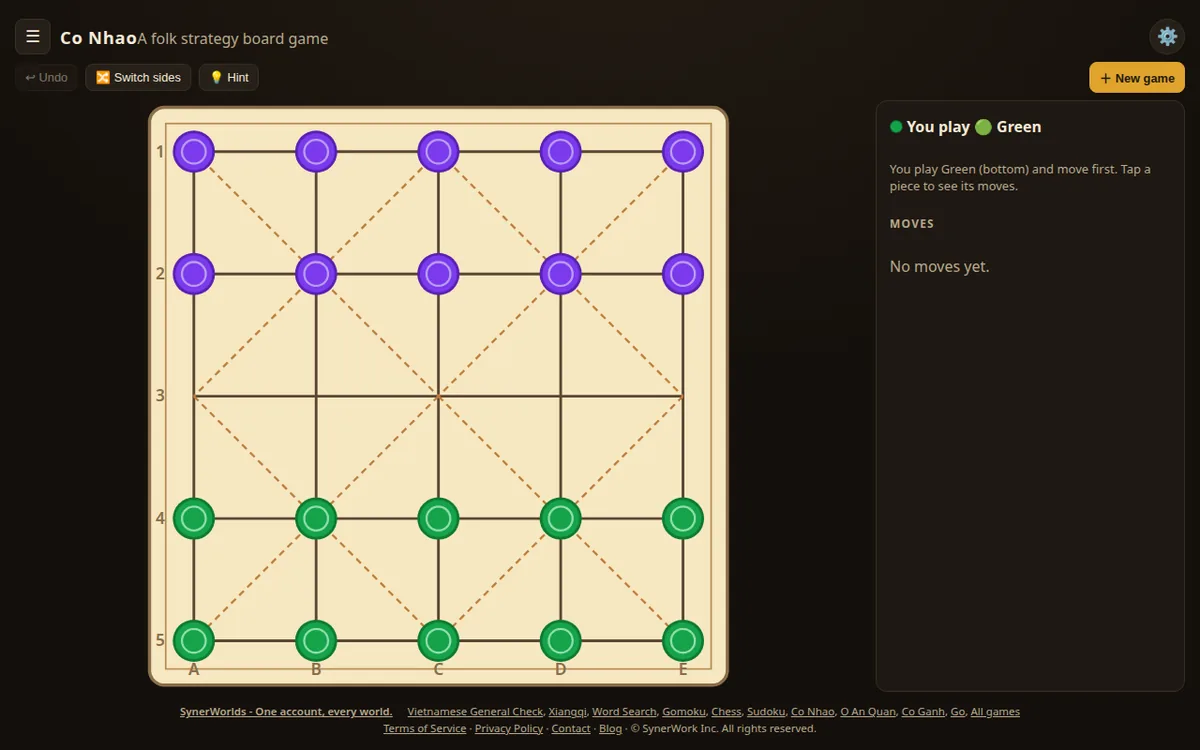
Common Cờ Nhào Mistakes: Parity Blindness, Self-Blocking, and Forgetting the Reply Chain
Four mistakes that make Cờ Nhào players lose games they don't understand: ignoring which points have diagonals, blocking your own last move, counting only your own chain, and breaking the opening wall too soon.
Σχόλια
Δεν υπάρχουν σχόλια ακόμη. Γίνετε ο πρώτος που θα μοιραστεί τη γνώμη του!