Cờ Nhào Tactics: Capture Chains and the Art of the Landing Square
Cờ Nhào tactics: capture chains and the art of the landing square
Cờ Nhào grants a freedom few capture games offer: capturing is never mandatory, and you may stop a jump chain whenever you like. That freedom is the game's depth — because the best move is usually not the longest chain, but the chain that stops at the right moment. This article covers the four decisions a decent Cờ Nhào player must make better than their opponent.
1. Read the landing square before the chain
Beginners read a jump chain by "how many discs does it take?" Strong players read it backwards: where will my disc be standing when the chain ends, and does it survive the reply? A three-disc chain that lands in the enemy's heartland and gets jumped straight back, with interest, is a losing chain.
Before the first jump, run the whole chain in your head and answer three questions about the final landing: is it next to an enemy disc with an empty point behind it (i.e., can it be counter-jumped immediately)? Does it have friendly support nearby? Does it set up a follow-up chain next turn? A chain that answers "no" three times should usually stop earlier — taking two discs and standing firm beats taking three and falling over.
2. Declining a capture — the patient player's weapon
Because capturing is optional, you may look at a jump that takes a disc and choose not to jump. Three situations call for declining regularly:
- The capture is bait. An opponent leaves a disc hanging exactly where your landing square feeds a longer return chain of theirs. The higher the level, the less often a "free" disc is an accident.
- The chain breaks your defensive shape. Your discs stand compact, covering each other; one chain drags a disc away and opens the group's flank. One disc gained doesn't pay for a group exposed.
- You should keep the tempo. Sometimes the position is already tilting slowly your way — your opponent is the one who needs something to change. One small capture can be exactly the change they were waiting for.
Asking "if I don't take, what will my opponent do?" is the turning point between a decent Cờ Nhào player and a mere jumper.
3. Think in networks, not straight lines
Chains in Cờ Nhào may change direction freely after every jump — a good chain rarely runs straight; it bends, loops, and sometimes returns near its start but on far better terms. To find such chains, don't scan the board disc by disc; scan by empty points: the empty intersection standing behind the most enemy discs is the hub of the longest chains.
A good eye-training exercise: before each move, spend ten seconds finding the longest chain possible on the board (even one you won't play). The daily Cờ Nhào puzzle on SynerWorlds is a compressed gym for exactly this — its positions are chosen so the optimal chain hides a second bend that untrained eyes miss.
4. The 1-vs-1 finish — a double-edged sword
Cờ Nhào's special rule: when each side has exactly one disc left, the game is an immediate draw. The player ahead on material must read this as a deadline: don't leisurely capture down to a lone enemy disc that slips into 1-vs-1, because your advantage is erased in one move. As the endgame approaches, keep at least two discs capable of finishing independently, and take the opponent's second-to-last disc only when you're certain there's no 1-vs-1 reply.
The mirror strategy is just as important: when you're heavily down on material, redirect everything toward reaching 1-vs-1. Losing further discs is acceptable, as long as your last disc survives until theirs is the only one left too. Many theoretically lost Cờ Nhào games have been saved by this single idea.
Where to practise
Play the computer at rising levels on SynerWorlds, and try setting yourself contracts: one session with the rule "never take the maximum chain — always stop one jump early and compare results"; the next session, the reverse. A few sessions like that teach you more about landing squares than hundreds of games jumped on instinct.
- Play now: Cờ Nhào
- Rules refresher: How to play Cờ Nhào
- Its sibling game: Cờ Gánh tactics: double captures, group surrounds, and the mandatory-capture trap
📚 Citește în continuare
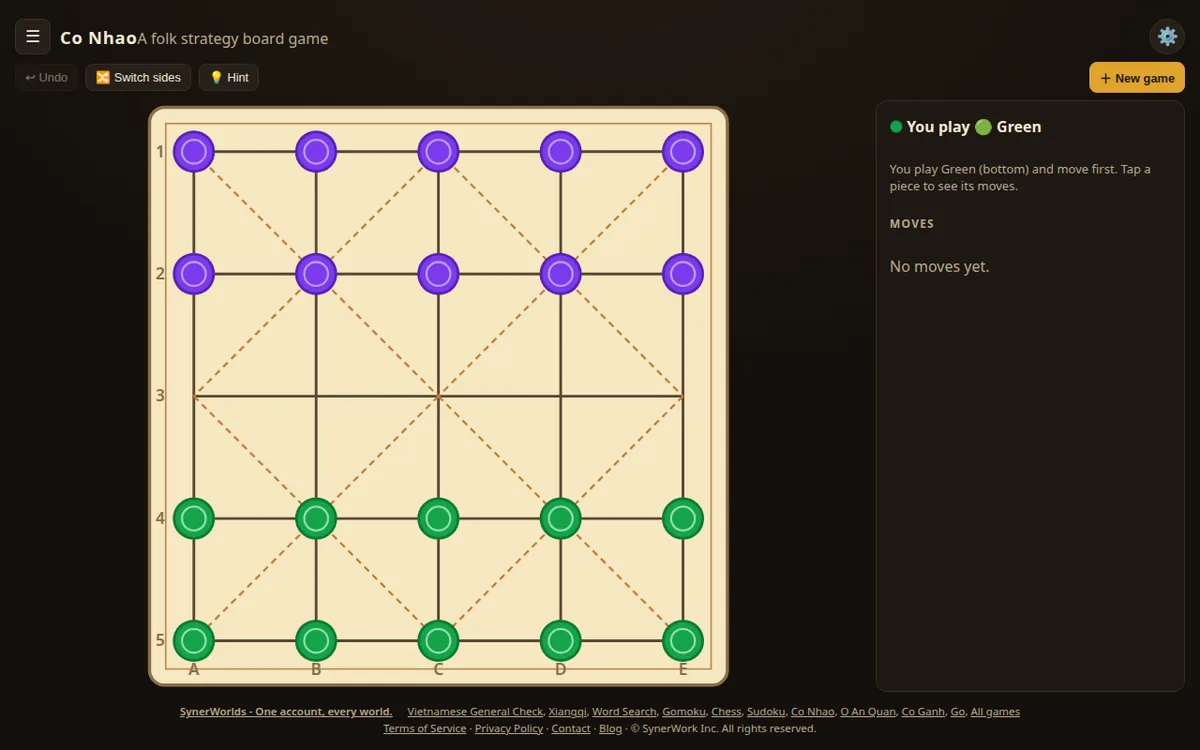
Common Cờ Nhào Mistakes: Parity Blindness, Self-Blocking, and Forgetting the Reply Chain
Four mistakes that make Cờ Nhào players lose games they don't understand: ignoring which points have diagonals, blocking your own last move, counting only your own chain, and breaking the opening wall too soon.
"Co Nhao — a beginner's guide"
Co Nhao** is a Vietnamese folk game on a 5×5 board (Alquerque-style). Each side has **10 discs**; the middle row starts empty. Green (bottom side) moves first. Win by capturing every enemy piece...
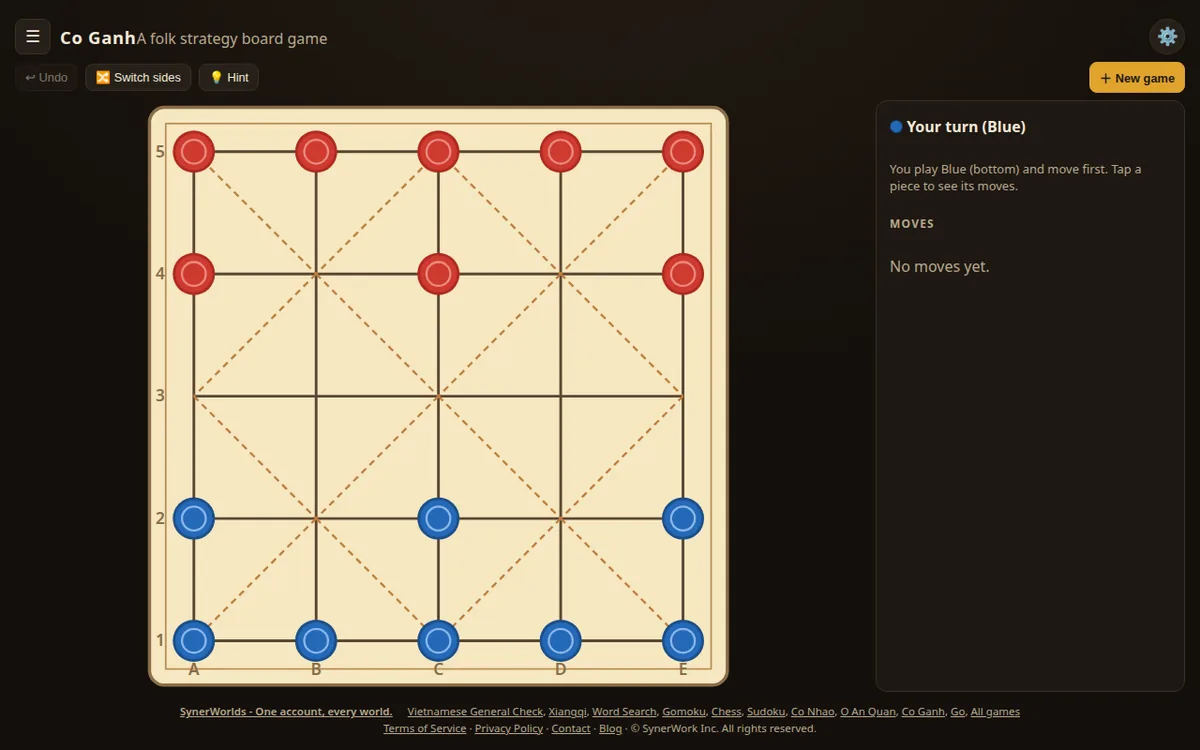
Cờ Gánh Endgames: Winning by Blockade, Liberty Races, and the Two Faces of the Fortress
As the board thins, Cờ Gánh becomes arithmetic: winning by leaving the opponent no move, liberty races between mutually surrounded groups, the endgame carry trap, and why a self-surround fortress can become a coffin.
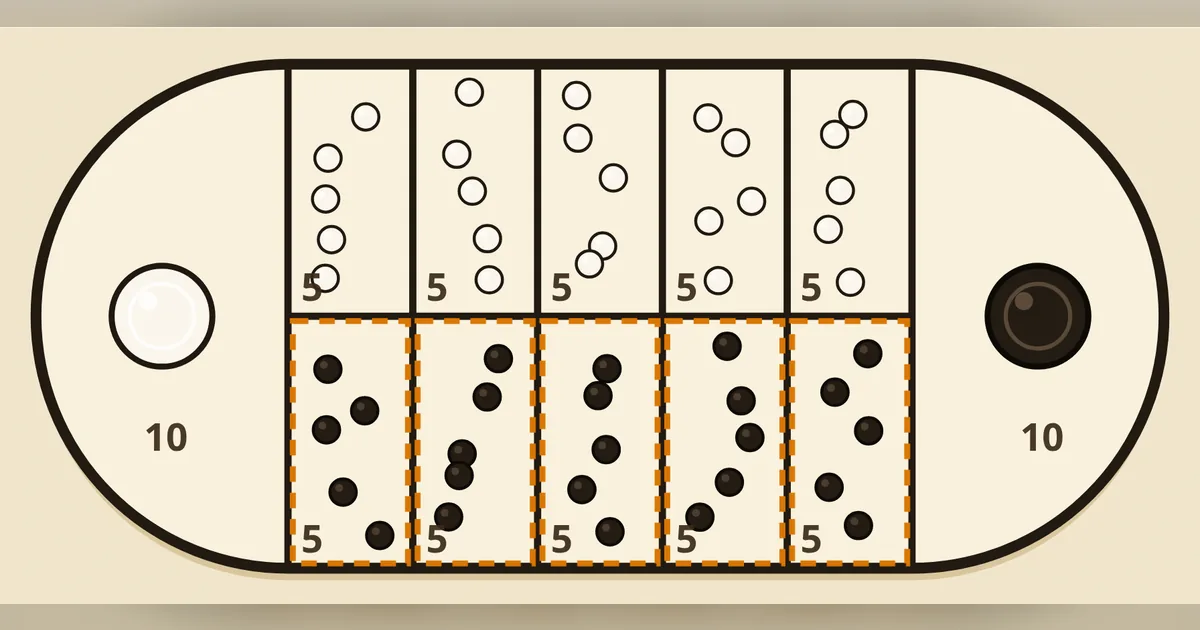
Ô Ăn Quan vs Mak Khom: One Mancala Family, Two Philosophies of Sowing
Vietnam's Ô Ăn Quan and Thailand's Mak Khom (หมากขุม) sow seeds into stores the same way but differ on everything else: free vs fixed sowing direction, forward chain captures vs the sideways kin thaen, a reseed tax vs a game-ending sweep — and which skills transfer.
Comentarii
Încă nu există comentarii. Fii primul care își împărtășește părerea!