Cờ Gánh Endgames: Winning by Blockade, Liberty Races, and the Two Faces of the Fortress
Cờ Gánh endgames: winning by blockade, liberty races, and the two faces of the fortress
The Cờ Gánh middlegame is a stage for double carries and group surrounds — visible, spectacular moves. The endgame is a different sport: as the board thins out, the game becomes arithmetic — counting remaining moves, counting breathing points, counting tempo. The four techniques below decide most balanced Cờ Gánh endgames, and all four get far less attention than carrying and strangling.
1. Winning by "no moves left" — no need to flip every enemy disc
Cờ Gánh ends in two ways: flip all the enemy's discs, or leave the opponent to move with no legal move at all. The second branch is seriously underrated. An enemy disc whose neighbouring points are all occupied or sealed cannot move — it is already dead standing, never flipped; and if every enemy disc is in that state, the game ends the moment their turn comes.
The subtle point is the difference between strangling and blockading: a strangle (chẹt) flips only enemy groups that touch the point you just landed on and have just lost their last breathing point; a blockade wins without flipping anything. But a blockade only ends the game when the opponent's entire army is immobile — one free disc wandering the far corner keeps the game alive. Sound endgame technique: count how many enemy discs can still move, and hunt that last mobile one instead of chasing discs that are already locked in place.
2. Liberty races: when two groups strangle each other
Endgames often produce two groups pressed together, each surrounding and surrounded. That is a pure breathing-point counting race: on your turn you seal one enemy liberty; the group that runs out of liberties first gets flipped when the opponent completes the surround with a move touching it.
Two variables break the simple count. First, the Open Rule does not pause for your race: if a carrying move appears anywhere else on the board, you must play it instead of sealing the liberty — and losing exactly one tempo loses the whole race. Before entering a liberty race, scan the full board for who holds a "distraction weapon" in the form of a forced carry. Second, connecting changes all the maths: a move that joins your group to another of your groups merges both liberty pools into one — a well-timed connection is often worth more than a sealing move, because it voids every count your opponent made before it.
3. The endgame carry trap: when exactly one carry is possible
The mandatory-capture rule is a rope in the middlegame; in the endgame it is a noose. The fewer discs remain, the easier it is to arrange for the opponent to have exactly one carrying move on the board — and with a single option, "mandatory" truly means mandatory; there is no room left for cleverness.
The trap recipe: leave a flippable pair where the disc the opponent lands to carry them simultaneously completes your surround of their larger group, or breaks a blockade you are weaving. The prerequisite is controlling how many carries the opponent can choose from: give them two carries and the trap halves in value. So the preparatory moves for a trap are usually quiet ones that prune the opponent's alternative carries — sealing an axis here, nudging a pair's end there.
4. The self-surround fortress: a safe house — and a coffin
Cờ Gánh law protects self-surrounded discs absolutely: your own move never flips your own discs, and a group with no breathing point left cannot be flipped by the opponent either — strangling a group requires landing on an empty point adjacent to the group to complete the surround, and a sealed group has no adjacent empty point. Such a fortress is permanently untouchable.
But the fortress has a lethal flip side in the endgame: locked discs cannot move. If your turn arrives and every disc you own sits inside a fortress or a blockade, you lose by the no-moves rule — the untouchable fortress becomes the coffin of its own builder. The endgame principle: fortify with your surplus discs all you like, but always keep at least one mobile "free" disc outside — that disc is the life insurance of the whole formation. And the attacking mirror: when an opponent over-fortifies, don't waste moves attacking the fortress; hunt down and immobilise their last mobile disc, and the fortress will lose the game for them.
Where to practise endgames
Play the computer at high levels on SynerWorlds and set yourself the goal of winning by blockade instead of by flipping everything — you'll be surprised how much earlier games end once the goal changes. The daily Cờ Gánh puzzle often hides a compressed endgame inside it, too.
- Play now: Cờ Gánh
- Rules refresher: How to play Cờ Gánh
- Read next: Cờ Gánh tactics: double captures, group surrounds, and the mandatory-capture trap · Common Cờ Nhào mistakes
📚 Læs videre
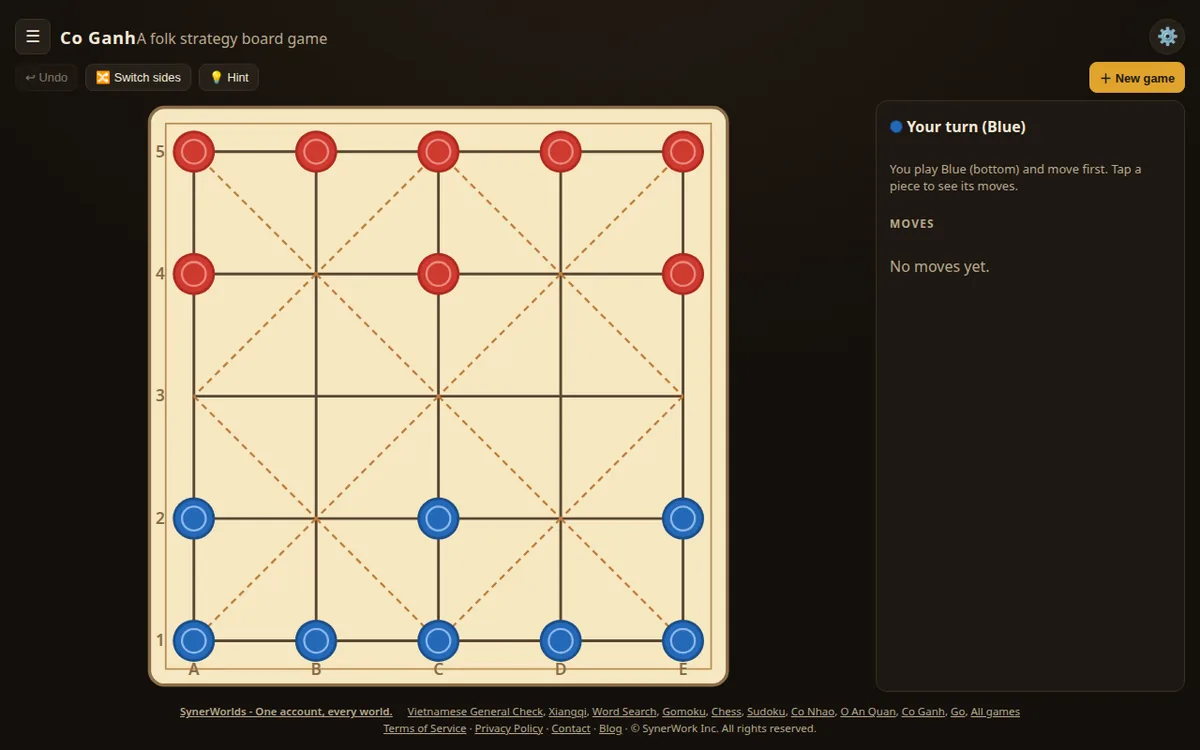
Cờ Gánh Tactics: Double Captures, Group Surrounds, and the Mandatory-Capture Trap
Force a bad mandatory capture, pre-load the axes for double carries at the centre, count breathing points to strangle whole groups — three ideas that decide strong Cờ Gánh games.
"Co Ganh — a beginner's guide"
Co Ganh** is a folk game of Vietnam played on a 5×5 board with diagonals at certain intersections (Alquerque-style). Each side has **8 discs** — red on the top two rows, blue on the bottom two...
Ô Ăn Quan vs Mak Khom: One Mancala Family, Two Philosophies of Sowing
Vietnam's Ô Ăn Quan and Thailand's Mak Khom (หมากขุม) sow seeds into stores the same way but differ on everything else: free vs fixed sowing direction, forward chain captures vs the sideways kin thaen, a reseed tax vs a game-ending sweep — and which skills transfer.
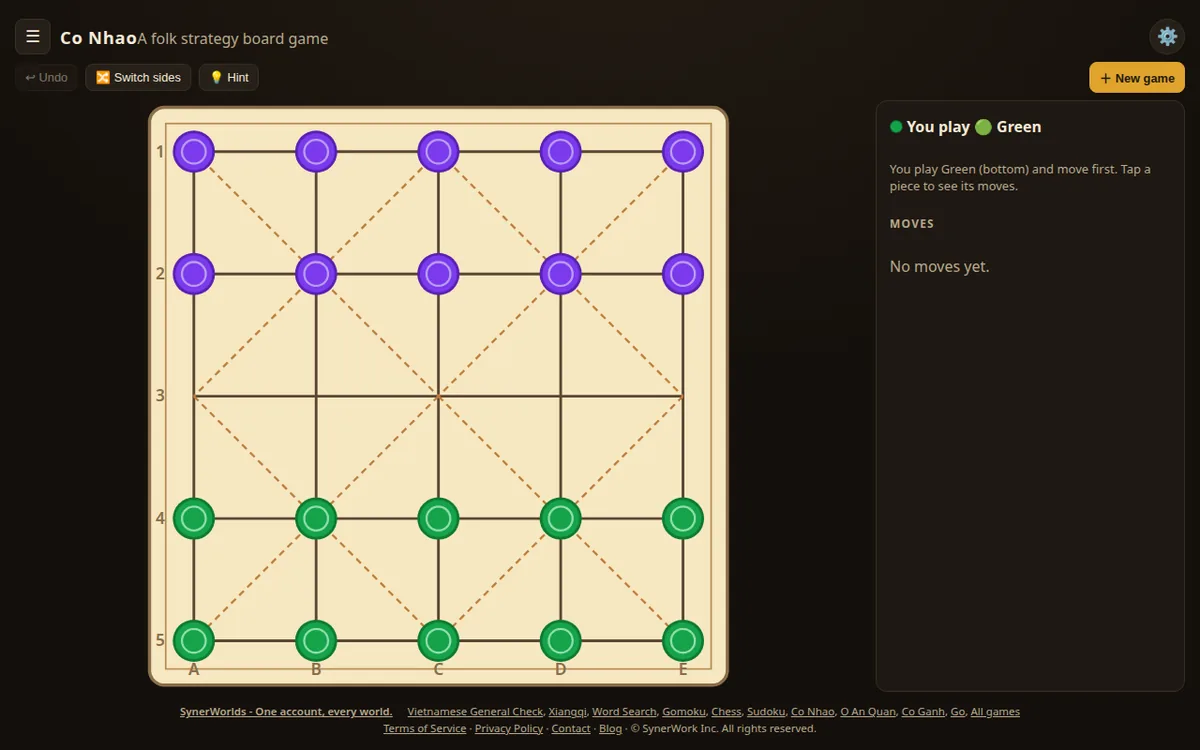
Common Cờ Nhào Mistakes: Parity Blindness, Self-Blocking, and Forgetting the Reply Chain
Four mistakes that make Cờ Nhào players lose games they don't understand: ignoring which points have diagonals, blocking your own last move, counting only your own chain, and breaking the opening wall too soon.
Kommentarer
Ingen kommentarer endnu. Vær den første til at dele dine tanker!